Unmanned Aircraft Systems (UAS) conducted a mission on Kīlauea Volcano's lower East Rift Zone to collect video of flowing lava in the upper lava channel of fissure 8. Scientists use the video to assess lava flow velocities, which are measured by tracking surface features in the stationary video view. Using UAS for this type of investigation has many advantages because the aircraft can hover above hazardous areas and it utilizes stabilized gimbals and mounts so that the video captured by onboard HD cameras is steady and smooth. Information obtained from this mission was relayed to Hawai‘i County emergency officials to aid in issuing emergency alerts and notices about the timing of evacuations. Video by the U.S. Geological Survey and Office of Aviation Services, Department of the Interior, with support from the Hawaiian Volcano Observatory.
Wednesday, June 6, 2018

Kīlauea Volcano - Midday Overflight (June 5)
A mid-day overflight on June 5 shows the ongoing partial collapse of Halema‘uma‘u at the summit of Kīlauea Volcano. To the north of the former visitor Overlook parking area (closed in 2008) is the site of the former lava lake—now a deep hole piled with wall-rock rubble. The western portion of Halema‘uma‘u has moved down and toward the center of the crater as new cracks form on the caldera floor to the west. Kīlauea's summit continues to subside due to the withdrawal of magma towards the volcano's East Rift Zone.
Lava tide from fissure 8 almost completely fills the Kapoho Bay
 |
Kapoho Bay before the Kilauea eruption. Source: Google Maps
|
Kapoho Bay completely filled by lava on the morning of June 5, 2018. Source : USGS
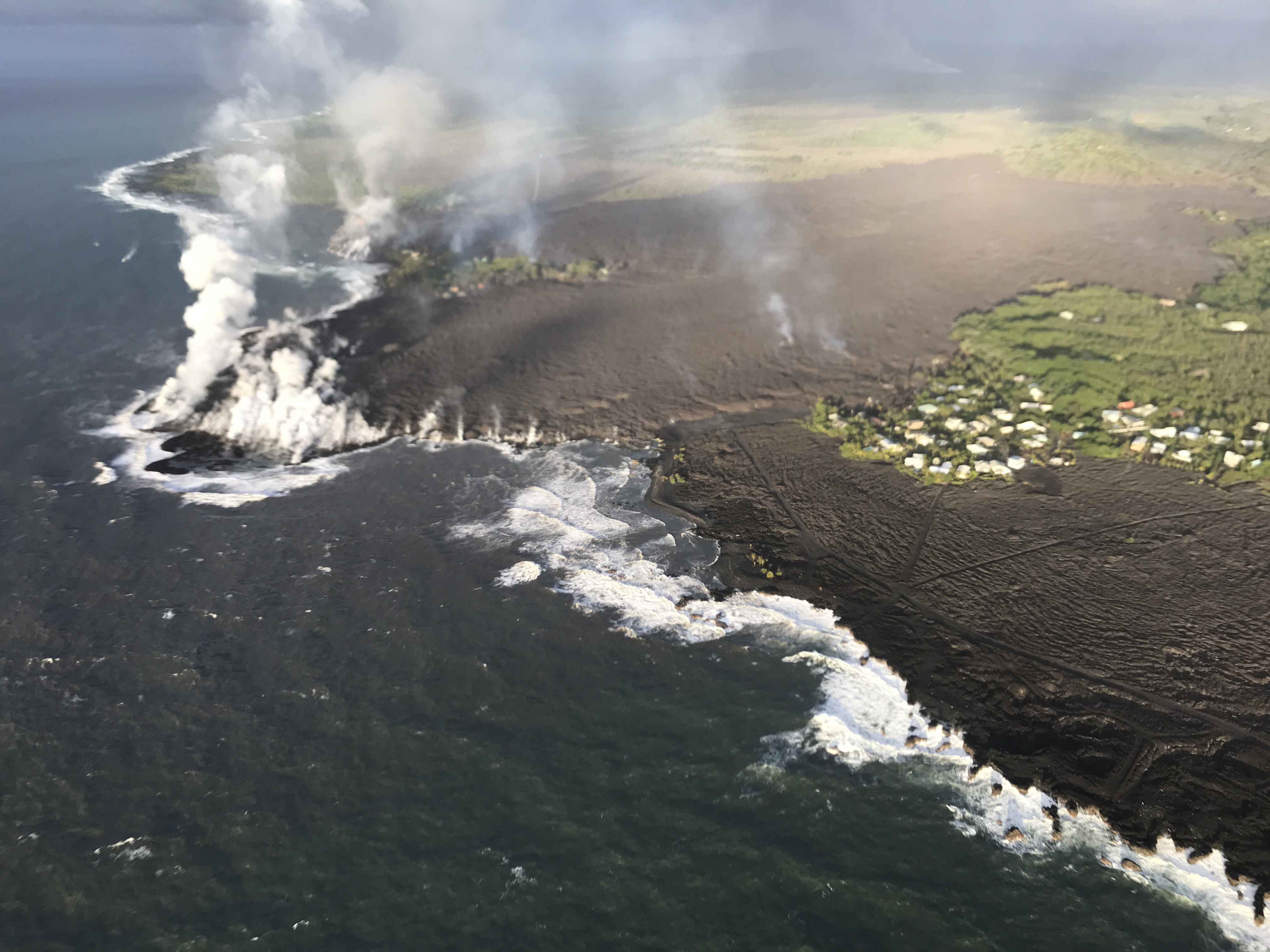
Images from the United States Geological Survey (USGS) show that lava tide from fissure 8 has completely filled the beloved Kapoho Bay and destroyed homes in greater part of the Vacation Land.
The destructive fissure 8 flow entered the ocean at approximately 10:30 p.m. Sunday evening to produce a delta that began to fill in Kapoho Bay in lower Puna. According to Jim Kauahikaua of the USGS, the bay already was halfway filled in by noon Monday, and the flow reached the north side of the bay, where Champagne Ponds is located, by Monday evening.
It is estimated that a total of159 homes were destroyed till now, which includes 42 homes recently destroyed in Kapoho Bay.
Janet Babb, the spokeswoman for the Hawaiian Volcano Observatory, said more than 20 square kilometers, or 5,000 acres, have been covered by lava since the eruption in the lower East Rift Zone began May 3.
The ocean entry of fissure 8 lava is about half a mile wide in some places, contributing to the high amount of lava haze called laze. Laze contains high amounts of hydrochloric acid along with tiny fragments of volcanic glass which can cause skin and eye irritation and difficulty in breathing.
Big Island has experienced more than 12,000 earthquakes since the Kilauea started spewing lava about a month back.
Here are some of the recent aerial photographs of Kapoho Bay and Kilauea
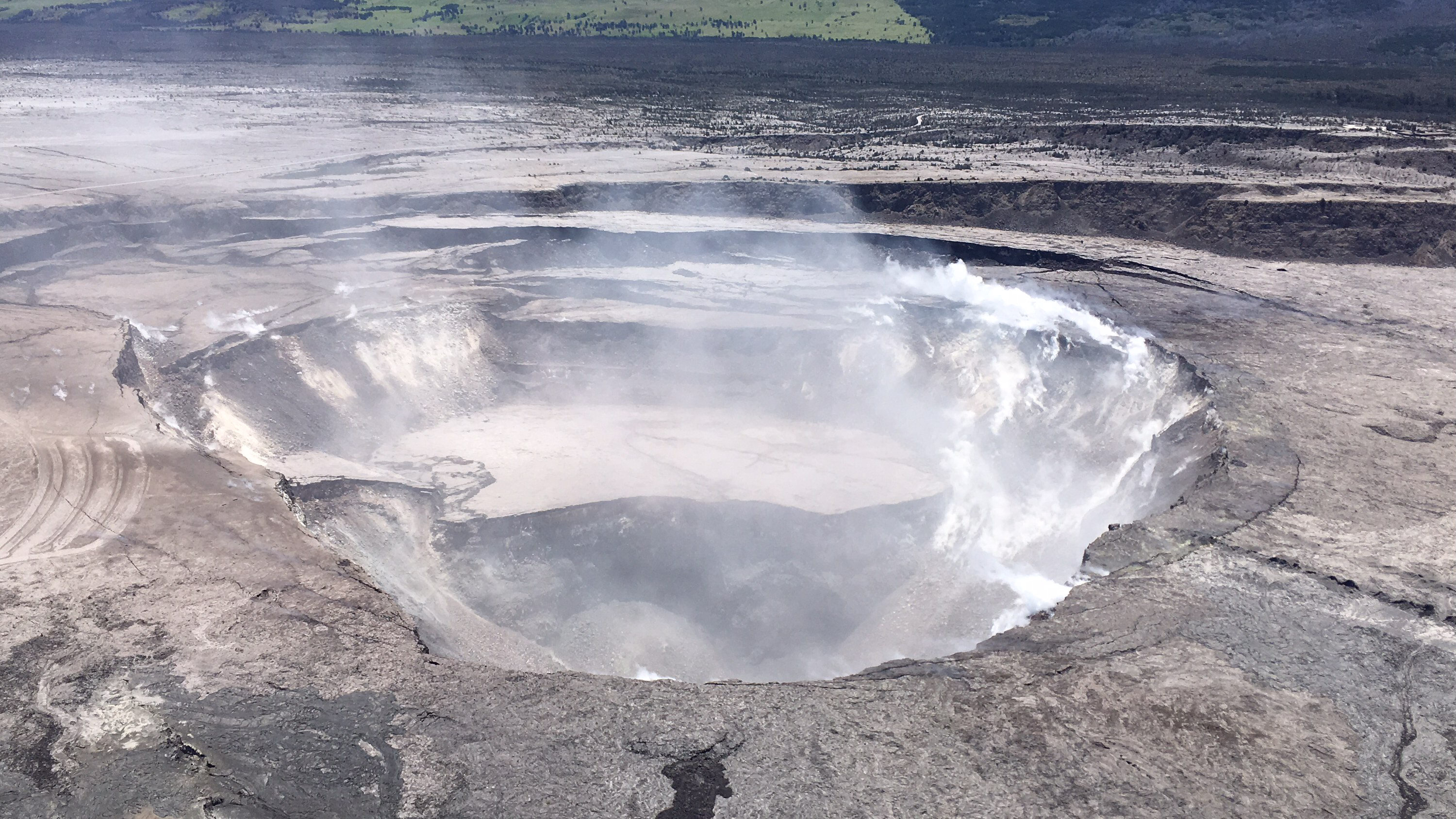 |
HVO scientists captured this aerial view of a much-changed Halema‘uma‘u during their overflight of the summit this afternoon. Explosions and collapse within Halema‘uma‘u have enlarged the crater (foreground) that previously hosted the summit lava lake, and the far rim of Halema‘uma‘u has dropped with continued summit deflation. The parking area for the former Halema‘uma‘u Overlook (closed since early 2008 due to volcanic hazards) can be seen to the left of the crater.
|
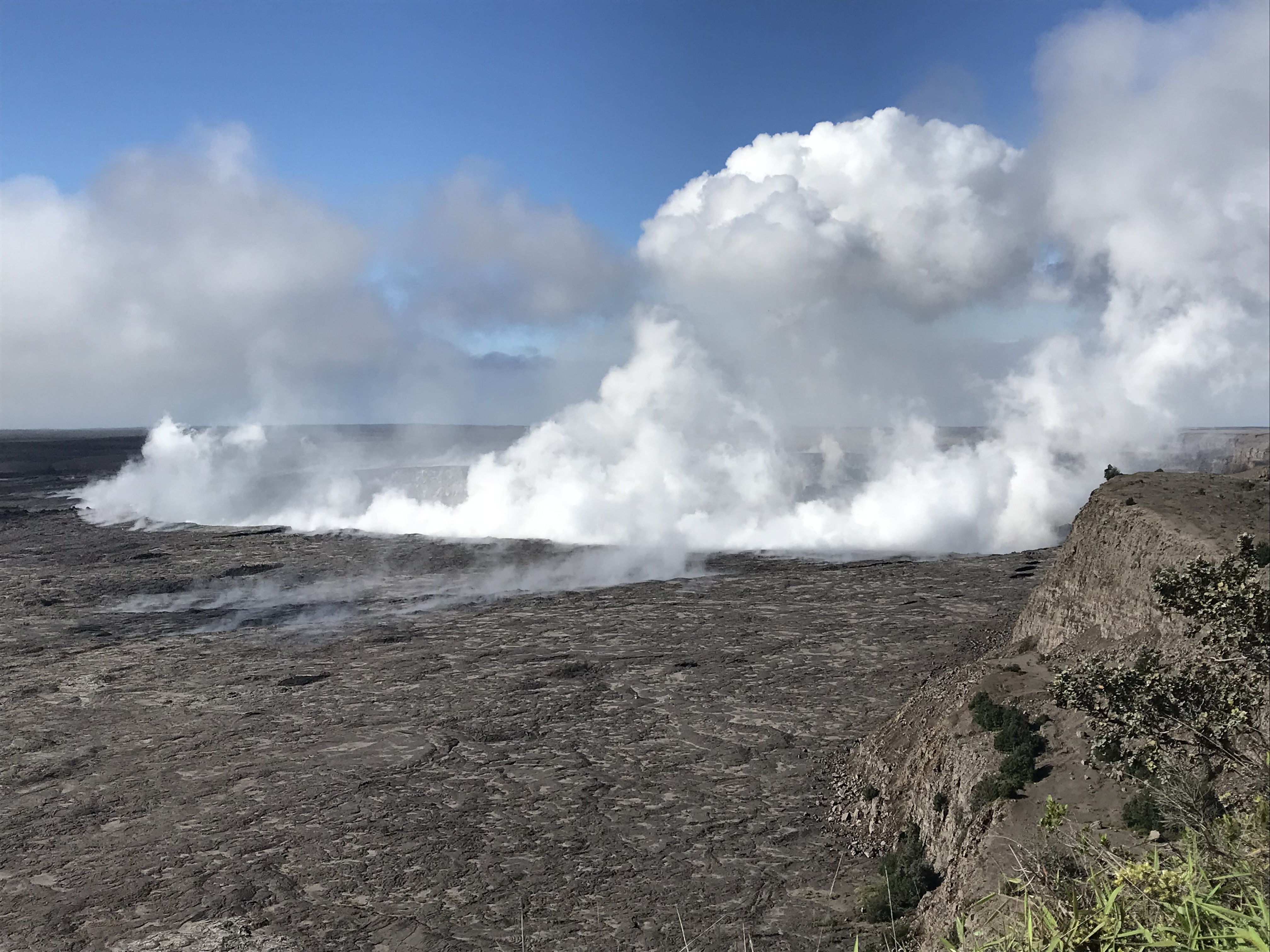 |
Morning view of Halema‘uma‘u and the adjacent caldera floor from the Kīlauea overlook. Heavy steam dominates the view, and strong winds are blowing the plume to the southwest.
|
Monday, June 4, 2018
Lava from fissure 8 meets ocean at the Kapoho bay
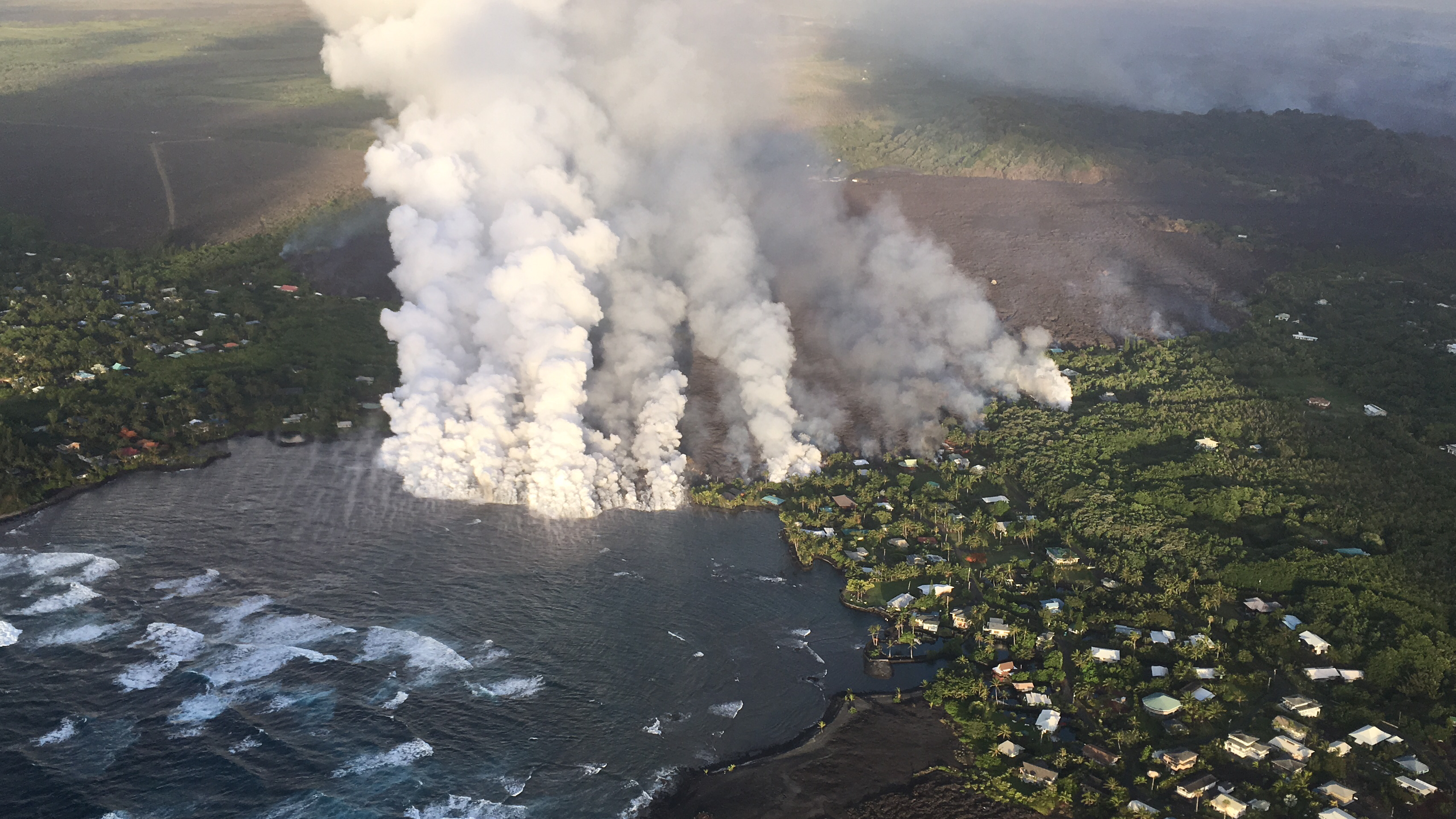 |
Overflight photograph at approximately 6:13 a.m. HST shows the lava flow originating from Fissure 8 (not visible in photograph) entering Kapoho Bay. The ocean entry was reported to have occurred by 10:30 p.m. on the night of June 3, 2018.
|
The lava from fissure 8 entered the ocean at Kapoho Bay at about 10:30 PM HST on June 3 generating a laze plume that is blowing inland but dissipating quickly. As of today morning, the lava is also constructing a delta in Kapoho Bay extending a few hundred yards into the bay.
The lava flow front is half a mile wide. A sluggish lava flow was observed in the vicinity of fissure 18 and rest of the fissures are all inactive.
Volcanic gas emissions remain very high from the fissure eruptions and also at the summit. Trade wind conditions are bringing vog to the south and west sides of the Island of Hawaii. Afternoon easterly winds may bring vog to communities in the Volcano area.
Inward slumping of the rim and walls of the walls of Halema`uma`u continues in response to persistent subsidence.
The USGS is predicting an increased earthquake activity in the coming days.
Some of the photos from USGS update today:
Video from helicopter overflight of Kīlauea Volcano's lower East Rift Zone on June 4, 2018, shows lava from fissure 8 entering the ocean at Kapoho Bay. View to the north.
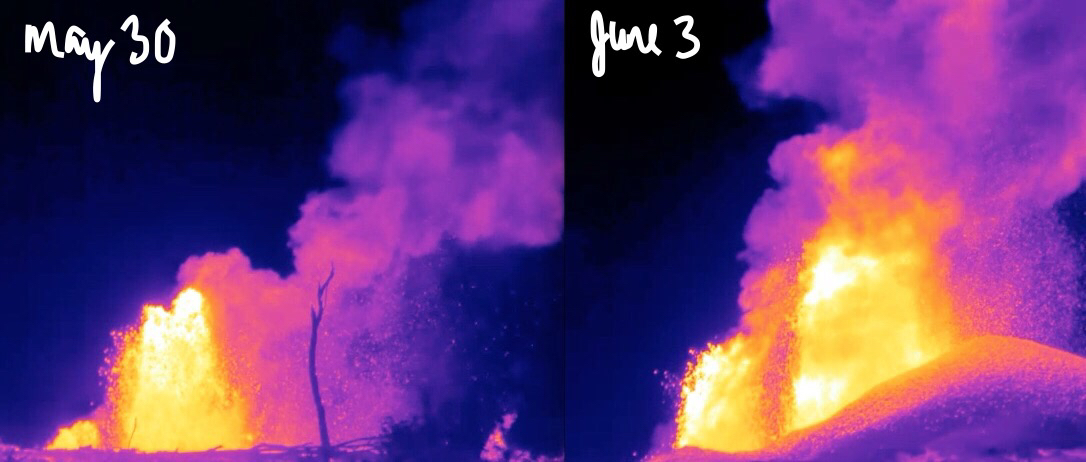 |
What a difference four days makes! These thermal images of fissure 8 fountains erupting on Kīlauea's lower East Rift Zone show a few things: 1) The lava fountains have gained height—with the tallest one growing from 150 ft to over 250 ft. 2) A pu‘u (cone) has built up downwind. 3) The amount of material wafting downwind is greater. Scientifically, we know the fountain temperatures are reaching up to about 2040 degrees F (1115 C). The composition of the lava erupted has high MgO (magnesium oxide) values, which comes from olivine crystals that are being pulled from deep in the rift zone.
|
Sunday, June 3, 2018
UAS mission films astonishing details of changes occurring within Halema‘uma‘u crater at Kīlauea's summit
This new U.S. Geological Survey aerial video reveals the astonishing changes within Halema‘uma‘u Crater and the vent that housed a 12-acre lava lake up until a few weeks ago. The vent is now about 100 acres and is devoid of lava as far as the eye can tell. Where did all that lava go? Is the vent capped in rock material now? When, or how could it, explode? These are the questions scientists will try to answer by studying this video and other data they are collecting about the ongoing changes with the #KilaueaEruption.
A UAS mission on May 31, 2018, filmed details of the dramatic changes occurring within Halema‘uma‘u Crater at Kīlauea's summit since explosive eruptions of ash and gas and ongoing wall collapse began in mid-May.
Clearly visible are steep, and in places, overhung crater walls, new cracks and faults that reflect ongoing subsidence of the area and intense steaming from a new collapse pit on the north margin of Halema‘uma‘u. Footage also shows yellow sulfur precipitate on the rubble-covered floor and a scattering of large ballistic blocks around the crater rim.
This video was taken from a UAS (Unmanned Aircraft Systems). Limited UAS flights into this hazardous area are conducted with permission and coordination with Hawai‘i Volcanoes National Park. The overflights collect visual information on what is happening at this rapidly changing eruption site. Scientists will be examining the footage in detail to understand how the expanding collapse area is evolving, the extent of ballistic debris, and other clues as to what is happening at Kīlauea's summit.
This information informs the assessment of hazards, which is shared with the National Park Service and emergency managers. Video by the U.S. Geological Survey and Office of Aviation Services, Department of the Interior, with support from the Hawaiian Volcano Observatory and Hawai‘i Volcanoes National Park.
Vigorous lava eruption continues from lower east rift zone of Kilauea
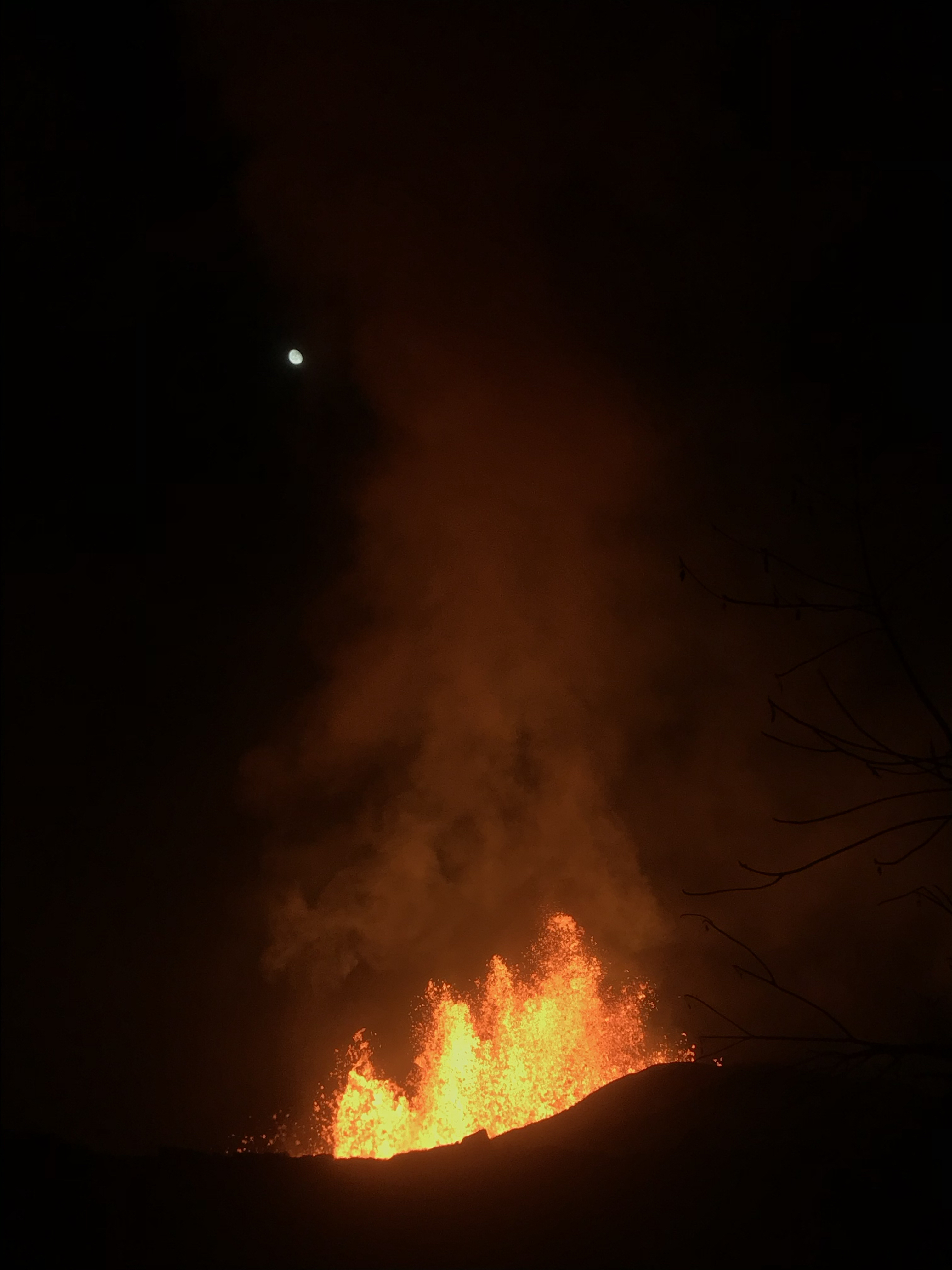 |
Overnight (June 1-2), fissure 8 lava fountains decreased to heights of about 50 m (164 feet). The moon can be seen in the upper left.
|
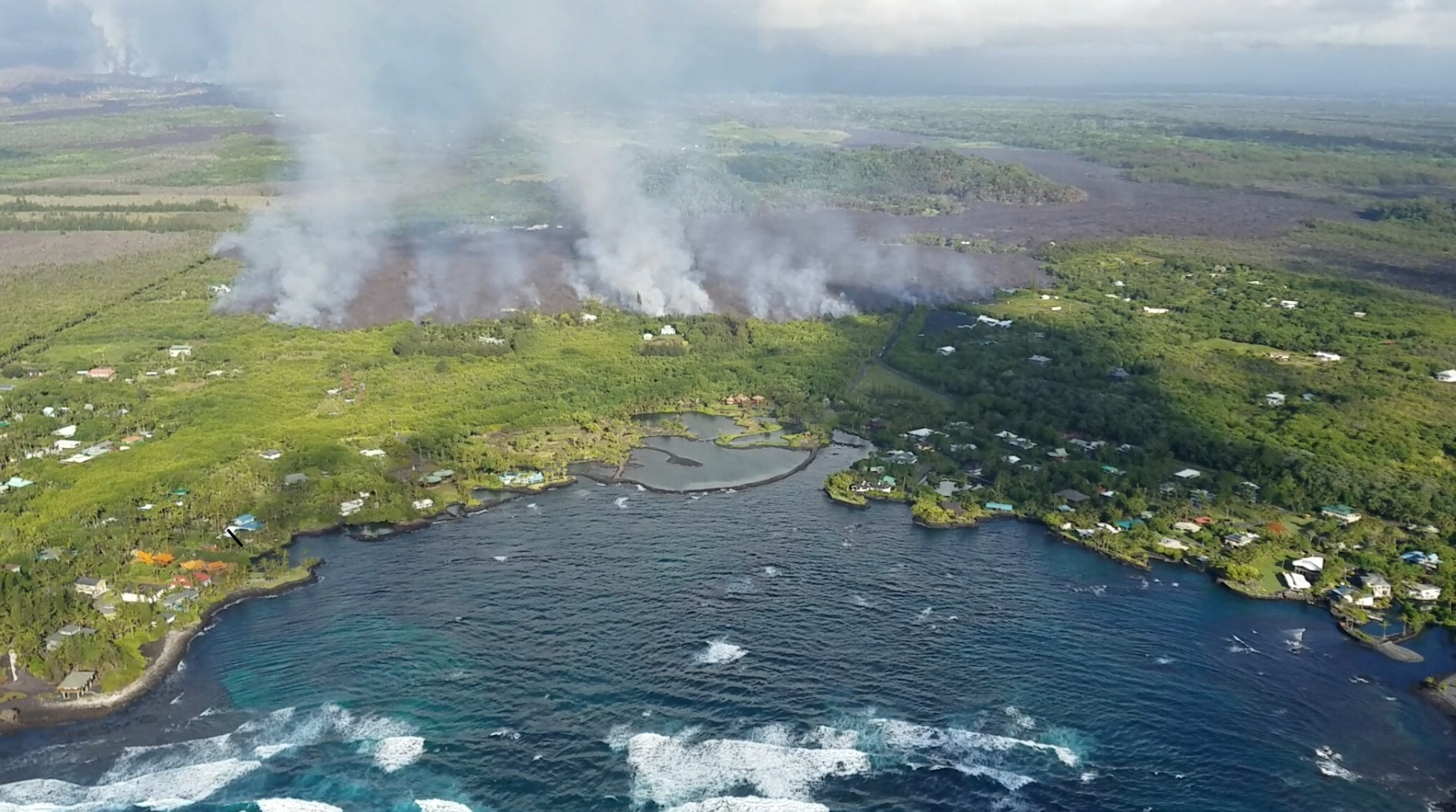 |
| Photo from 7AM helicopter overflight, hovering offshore and looking up the flowfront. Nearly all of the front was active and advancing; advance rates were estimated at an average of 250 feet/hour (76 m/hr), and as of 7AM the flow was 500 yards (457 m) from the ocean.
This video was taken on the June 3 7AM HST helicopter overflight, hovering offshore and looking up the flow front. Nearly all of the front was active and advancing; advance rates were estimated at an average of 250 feet/hour (76 m/hr), and as of 7AM the flow was 500 yards (457 m) from the ocean.
|
Mount Kilauea continues to erupt lava one month after it all started on May 3, 2018. Fissure 8 is persistently fountaining since a week delivering lava northeast along Highway 132 to the Kapoho area. The lava stream was about 430 yards from the ocean at the Kapoho Bay between Kapoho Beach Road and Kapoho Kai Drive.
All other fissures are silent now, although Fissure 9 is steaming heavily.
Pele's hair and other lightweight volcanic glass from high fountaining of Fissure 8 are falling downwind of the fissure and accumulating on the ground within Leilani Estates.
Earthquake activity at the summit was high overnight, and it is possible that a small explosion, much like those that have occurred during the past two weeks, will take place in the next day. Ash emissions are low as revealed by webcam views this morning. Volcanic gas emissions at the summit remain high.
Here are some of the latest photos by United States Geological Survey
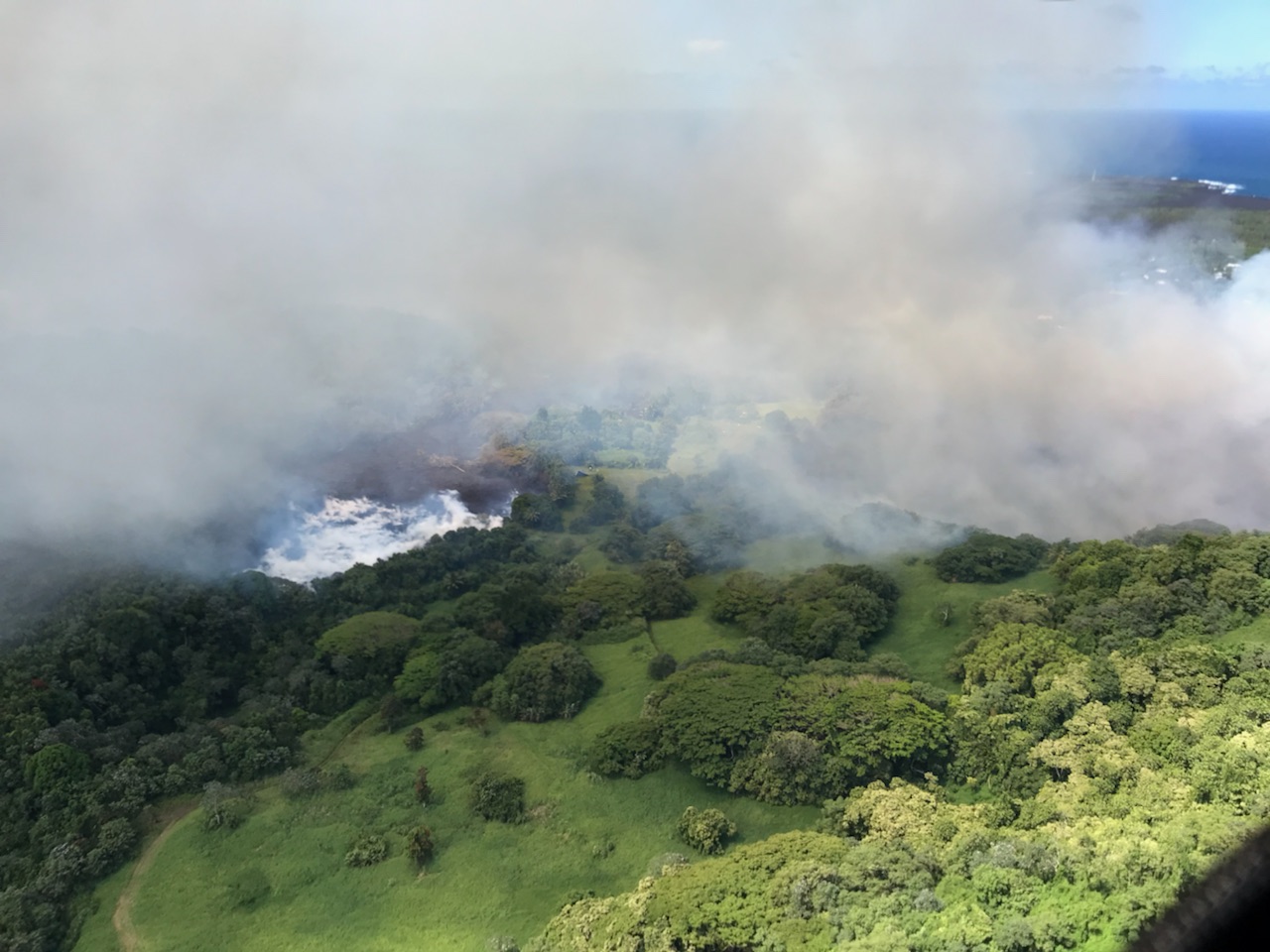 |
| As fissure 8 lava flowed into Green Lake, the lake water boiled away, sending a white plume high into the sky—visible from afar between around 11:30 a.m. and 1:30 p.m. HST. This aerial photo, taken a couple of hours later by the Hawai‘i County Fire Department, shows still-steaming lava within Green Lake, located near the intersection of Highways 132 and 137. |
 |
Summit plume at 8:40AM HST on June 3. A slight mist in the air softens the look of the plume, which is predominantly white steam with very minor amounts of ash.
|
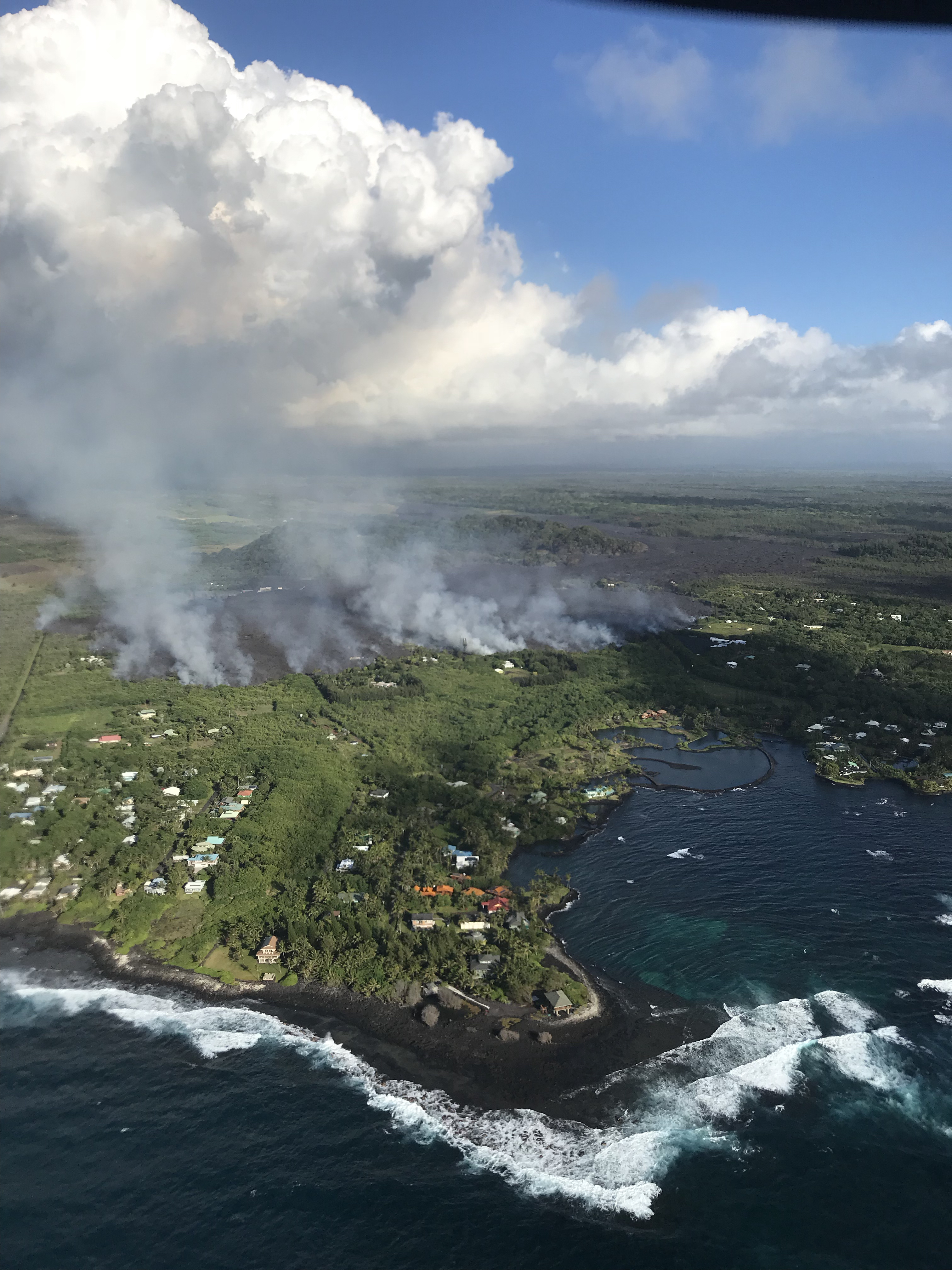 |
| Overflight photo at 7AM HST from offshore looking up the flowfront. Nearly all of the front was active and advancing/spreading. |
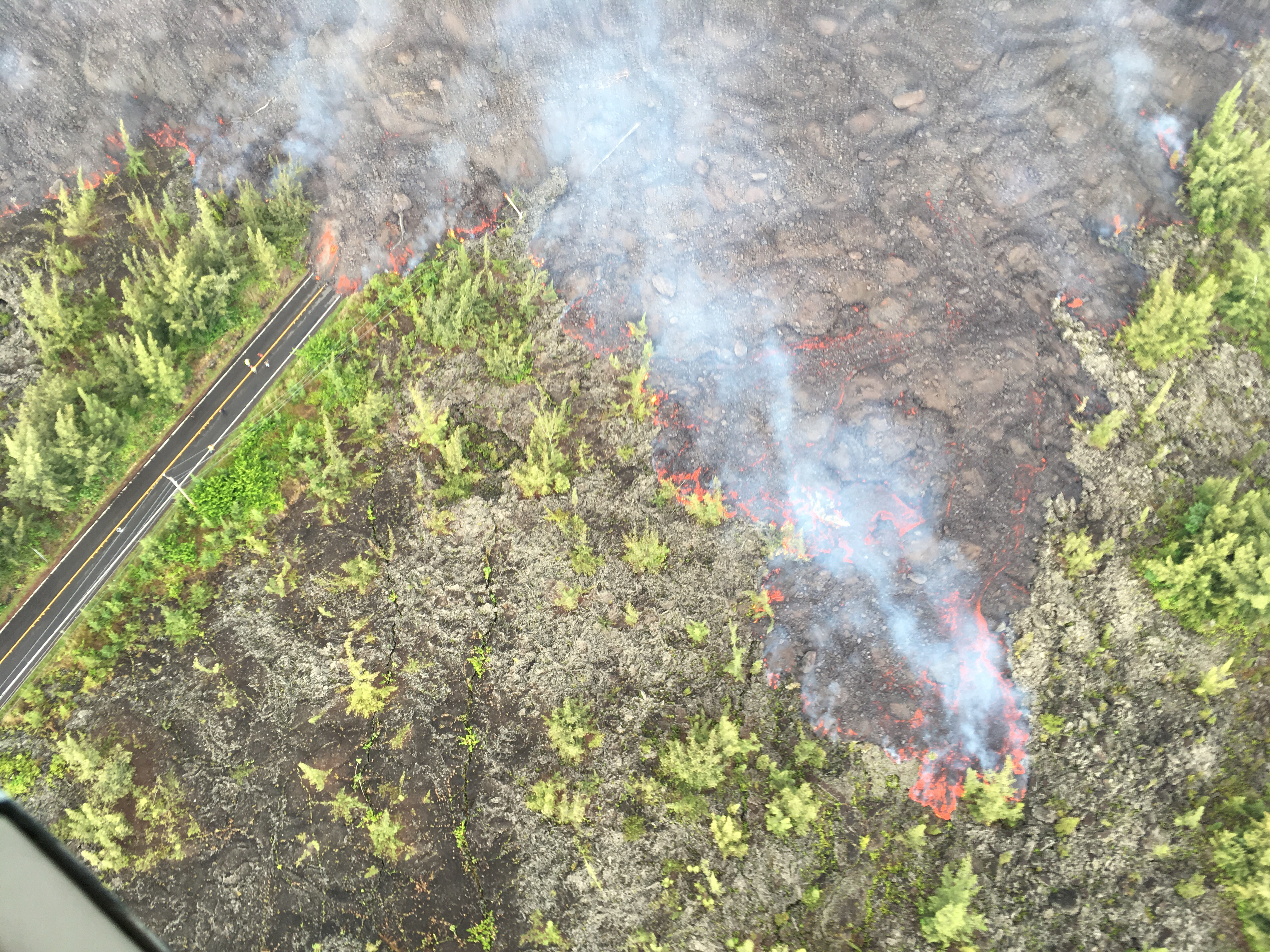 |
Overnight (June 1-2), fissure 8 lava fountains decreased to heights of about 50 m (164 feet). The moon can be seen in the upper left.
|
Saturday, June 2, 2018
The Rare, Giant corpse flower at Foster Botanical garden has bloomed
 |
| The giant corpse flower with the spathe cut open |
A rare, giant Titan Arum, or "corpse flower," has bloomed at the Foster Botanical Garden, Honolulu, Hawaii. The flower is 6 feet 3 inches tall, towering over the neighboring plants in the hot-house at the garden.
 |
| The unbloomed corpse flower photo by Hawaii News Now |
The plant does not have a regular blooming season and sometimes decades go by between the sporadic blossoms. Once bloomed, it is expected that the bloom will last for 24-48 hours after which it collapses rapidly.
The flower is named after the pungent odor the bloom emits which resemble a decaying animal or corpse. Why the strong and pungent smell? It all comes to the continuation of species. The smell, color, and temperature are all means for attracting insects for pollination to continue the species. Dung beetles, flesh flies, and other carnivorous insects are the primary pollinators of this type of flower.
 |
| The male and female flowers at the base of the spadix or phallus |
 |
| The beautiful burgundy skirt and the phallus |
The corpse flower has designed a very clever way of fooling the insects into believing that it is a piece of flesh/ dead animal due to the smell, warming itself up to 98 degrees Fahrenheit (36.7 Celsius) and the burgundy color, attracting the beetles. Eventually as the insect take-off after sitting on the flower, they have pollens sticking on their legs for pollinating another flower. Once this task is completed the flower collapses and shrivels up.
The scientific name of the corpse flower is Amorphophallus titanium. (from Ancient Greek amorphous, "without form, misshapen" + phallos, "phallus", and titan, "giant"). The legendary Sir David Attenborough first used the name titan arum to refer to this magnificent tropical plant in the BBC series 'The Private Lives of Plants' because he felt viewers might be offended by the plant’s Latin name, Amorphophallus titanum.
The corpse flower is not a single flower but an inflorescence (a stalk of many flowers). It consists of a mixture of tiny male and female flowers clumped together at the base of phallus-like structure called (spadix) surrounded by a beautiful pleated skirt-like covering (spathe) that is bright green on the outside and deep maroon/ burgundy inside when opened.
The female flower precedes the male flowers to maturity; hence self-pollination is not possible, requiring the help of insects.
The inflorescence which can grow over 3 meters (10 ft) in height rises from the tuber, which is a large spherical underground stem modified to store food for the plant. It is very large and weighs around 100 pounds. After the inflorescence withers-off, a single leaf sprout from the tuber reaching a height of 6-7 meter and branching into numerous leaflets. Every year the leaf withers and new emerges till the plant is ready to flower again. This cycle continues through 40 years which is the total lifespan of this plant
If pollinated, the stalk grows into a large club like head of orange seeds.
The corpse flower was first discovered in Sumatra in 1878 by Italian botanist Odoardo Beccari, according to the UC Botanical Garden. The plant grows in the wild only in tropical rainforests of Asia. It is an endangered plant because of habitat destruction in most part of Indonesia, decrease in insect population that pollinate the plant and help in seed distribution. Indonesia has probably lost 72% of its native rainforests and the deforestation continues.
The plant is very difficult to cultivate, and only a handful of places across the globe have been successful in doing so! It also requires 7-10 years of vegetative growth before blooming for the first time. There are about 100 cultivated corpse plants around the world.
Plants like this are magnificent and make us realize the complexity and biodiversity of the botanical world.


 |
| The pleated skirt |
 |
| The beautiful skirt |
 |
| The edges of the skirt |
 |
| The collapsed corpse flower courtesy: Foster Botanical Garden Time-lapse video of corpse flower bloom
Watch the
corpse flower bloom in this captivating and astonishing time-lapse video. The
Chicago Botanic Garden’s rare titan arum bloomed and opened over an exciting 24-hour
period after growing for more than 11 years.
|
Subscribe to:
Posts (Atom)