Showing posts with label plumeria. Show all posts

Friday, June 8, 2018

King Kamehameha the Great adorned in leis at the annual lei draping ceremony

King Kamehameha the Great adorned in leis

The 146th Annual Lei Draping ceremony of the King Kamehameha statue took place today at the Ali'iolani Hale at 3PM - June 8th, 2018 to honor King Kamehameha the Great.

Keeping in with the Hawaiian tradition, beautiful handmade leis were draped on the outstretched arms of King Kamehameha. A Honolulu Fire Truck was used to drape the leis. City crews and volunteers started sewing the 30 feet plumeria lei on Thursday morning.

The Lei draping ceremony also incorporated a royal court performance, Hawaiian music, and entertainment!

Musical guests this year featured the Royal Hawaiian Band and Raiatea Helm.


The Royal Hawaiian Band 

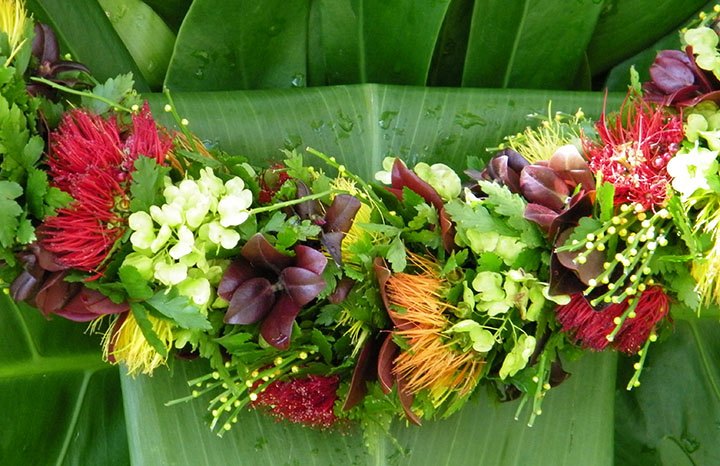
The plumeria lei

King Kamehameha the Great is also known as Kamehameha I and Kamehameha the First, was the monarch of Hawaii between 1782 and 1819. He is well-known and respected for uniting and establishing the Kingdom of Hawaii in 1810. Kamehameha Day is held in his honor on June 11 each year.

In 1871, Kamehameha V who is the great-grandson of Kamehameha the Great, passed a royal decree that Kamehameha Day should be celebrated. The first Kamehameha day was observed on June 11, 1872, and was one of the first State holidays celebrated after Hawaii became a US state in 1959.

Today, Statues of Kamehameha the Great are in 3 cities in the state of Hawaii, namely Honolulu, Kapaau, and Hilo. Outside the state, there is one statue in the National Statuary Hall on the US Capitol in Washington DC. 

During the Kamehameha Day ceremonies, all these statues are draped in lei.

The statue of King Kamehameha in front of Ali‘iōlani Hale was commissioned in Florence, Italy. 

King Kalākaua, the seventh monarch and last king of the Hawaiian Kingdom ordered to commission a statue in Florence, Italy to commemorate the  founder of the Kingdom, King Kamehameha the Great 

On its way from Europe, the ship carrying the bronze statue sank off the Falkland Islands. As the statue was insured, King Kalākaua ordered the second statue.  In the meantime, the first statue was recovered, and Honolulu soon had two statues. To honor the birthplace of Kamehameha, King Kalākaua gifted the original statue to the people of Kohala. The second statue stands proudly in front of Ali‘iōlani Hale.

Ali‘iōlani Hale is home to Hawai‘i’s Supreme Court and the King Kamehameha V Judiciary History Center.

The regal women of ‘Ahahui Ka‘ahumanu society string the 30 feet long plumeria lei which serve as a base of lei on the statue – Other leis are adorned on top of these plumeria lei. The Kaʻahumanu Society (official name: ʻAhahui Kaʻahumanu) is a civic club in Hawaii formed by Princess Victoria Kamāmalu in 1864 for the relief of the elderly and the ill. The club celebrates the life of Queen Kaʻahumanu and the preservation of Hawaiian culture at special events like Kamehameha day parade.

Kamehameha Day is officially on Monday, June 11, 2018. The celebrations of the day kicked off today by the lei draping ceremony. This will be followed by a floral parade on Saturday morning, fairs, carnivals and running, horse and cycle races and Hula competitions.

Some of the photos during today ceremony


The lei is ready 


The lei in making 


Carefully getting the lei on the outstretched hand of the statue


The fire truck to adorn the lei 


Blessing of the Lei by the Hawaiian priest 

Carefully lifting the lei from ground 

Draping the statue 

The lei Queen 


The plumeria lei ready to be adorned 

Waiting for adorning the lei 

People watching the ceremony 

Plumerai Lei 


Saturday, October 14, 2017

We say it all with a Lei: Aloha, welcome, goodbye and much more


As soon as you step off the plane and set your foot on this tropical paradise on earth, you get a warm welcome with a traditional lei or floral garland and you instantly get into the spirit of ‘Aloha’. In fact, there is a lei stand at each airport. It’s the island way of welcoming the guest to our ‘Aina’. 

Specialized airport lei greeting services are also provided by many small businesses to welcome the guests at airports.

Lei is the Hawaiian word for garland or wreath. The tradition of lei was introduced in Hawaiian Islands by early Polynesian voyagers who arrived here from Tahiti, sailing in canoes and navigating by guidance from stars. In ancient times, the Maile lei was offered as a part of peace agreement between heads of opposite clan.


making of lei 


They used to make lei form various materials like nuts, feathers, seeds, flowers, leaves and even bone and teeth of various animals. There are leis worn and exchanged for every important occasion in life like for grief, for love, lei for love-making and marriages, for a birth in family.  Lei was worn when farmers blessings the new crop, fisherman’s going out to sea for catch or people going on voyages, priest chanting in the heiau.

Most common people in Hawaii used to wear open-ended horseshoe fashion, long lasting lei made of the spicy scented green maile stems and leaves. Maile is a native Hawaiian vine, with shiny fragrant leaves and the lei very popular at weddings, graduations and especially proms.

The maile is the most traditional wedding lei, as it was used by the Kahuna (Hawaiian priest) in old Hawaii to bind the hands of the bride and groom, symbolizing their commitment to each other.


Maile

Most visitors are only familiar with the plumeria lei, because it is widely available at airports and hotels. The plumeria is a relative newcomer in the old tradition of making lei with pikake, jade vine and Ilima . Harder to find is the lei pikake with its unequaled perfume.


Plumeria lei courtesy: getty images
pikake lei 
Modern lei makers have embraced making lei from other flowers not tropical to Hawaii like orchid leis, new scented flowers, seeds and nuts, and long-lasting flowers such as the Cigar (kika) flower catering to the taste of nearly 9 million tourists that visit the islands.


lei making 

orchid lei 

King Kamehameha draped in Lei 

Lei for sale


Today, Leis are a symbol of appreciation, love, affection, respect and is perhaps the physical manifestation of Aloha spirit. Lei are available all through the island and can also be shipped on order. 

May 1st is celebrated in Hawaii as Lei Day, when rest of the world commemorates it as Labor Day. “May Day is Lei Day in Hawaii Nei” is a very popular phrase here.  The entire day is filled with festivities, colorful pageantry and lei day parade. A Royal court procession announce the Lei day king and queen  with blowing of conch. 

Lei making competitions are also a part of festivities for that day.

The royal court procession has eight princesses, each representing a different Hawaiian island -- accompanied by a man carrying a kāhili -- a feathered staff used in ancient times as a symbol of royalty.

Each of the 8 Hawaiian Islands has its own official color and lei, based on a flower or foliage that is endemic to that island or once thrived there. The Lei Day princess wears the color of the island she is representing and be draped in the proper accompanying lei. The following is information about 8 islands and the respective lei adapted from Kings Hawaiian blog contributed by Marie Tutko.

  • White: Niʻihau, “The Forbidden Isle,” and a lei of made of pūpū(shells). Niʻihau is the only island represented by a shell, as its residents are famous for the intricate lei they craft out of shells that can only be found on that island.
  • Purple: Kauaʻi, “The Garden Isle,” and a lei made from the rare, anise-scented mokihana berry.
  • Yellow: Oʻahu, “The Gathering Place, and a lei of golden ʻilima flowers.
  • Green: Molokaʻi, “The Friendly Isle,” and a lei of polished kukui (candlenuts).
  • Orange: Lānaʻi, “The Pineapple Island,” (because of the island’s long history as a pineapple plantation) and a lei of kaunaʻoa, a native, leafless vine.
  • Gray: Kahoʻolawe, “The Target Island,” (the uninhabited island was used by U.S. Armed Forces for live-fire training and test explosions for decades), and a lei of hinahina, a native, silvery heliotrope that grows on the beach.
  • Pink: Maui, “The Valley Isle,” and a lei of lokelani (a small rose).
  • Red: The island of Hawaiʻi, “The Big Island,” and lei of ʻōhiʻa lehua, a native honey plant. The red ʻōhiʻa lehuais often the first shrub that will sprout from a recent lava flow.
Lei day competition 

Winning lei at Lei day Photo: Joel

Aunty Amelia Bailey creating a beautiful haku lei. Photo courtesy of Hawaii Tourism Authority (HTA) / Tor Johnson.

Mayor with Lei day queen 

Etiquette's of Lei

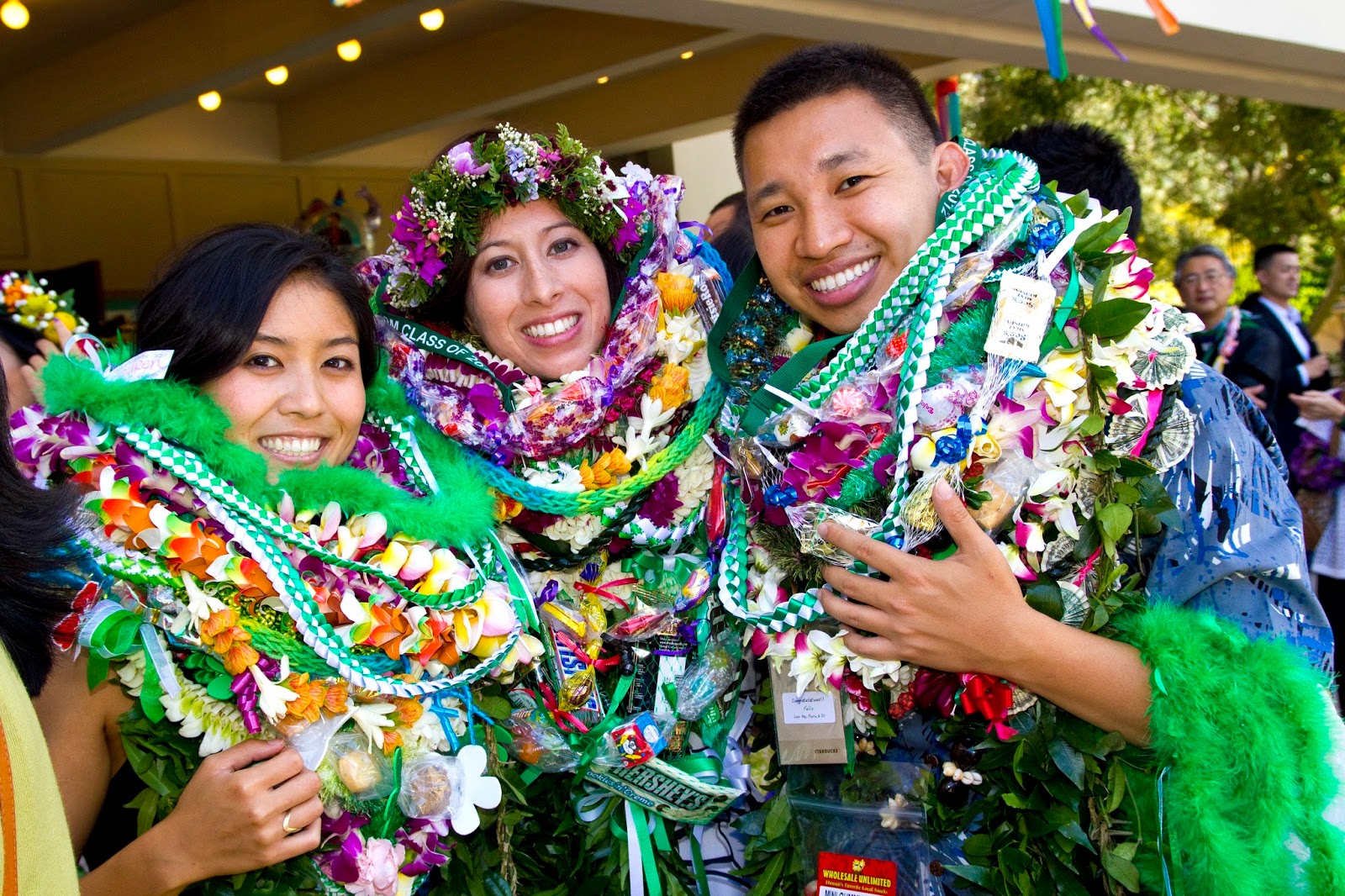
graduates at commencement 
There are some do and don’t with a lei in Hawaii. In Hawaii, Lei is not worn like a necklace but it should be elegantly draped with a little length hanging from front and back.  Always accept a lei with a smile and a kiss on the cheek or a hug. When someone makes you a lei, it is said that they’ve put a part of themselves in it. Never remove the lei in front of the giver.


Last, but not least, there is one more taboo…never present a pregnant woman a closed lei. Hawaiians feel that a closed lei around the neck is bad luck for the unborn child. (Head Hakus and open-ended leis are acceptable to give to pregnant woman.)

Finally, there is also tradition to dispose of lei properly. It should never be thrown in garbage. It should be returned to nature by hanging on the tree, burying it or unstringing it and offering the flowers to the sea.

Now, knowing more about the history and etiquettes about lei, I am sure you can’t  resist the vibrant colors, the intoxicating fragrances, or the beautiful tradition of Hawaii’s most recognized icon…the flower lei. Simply enjoy the lei for its beauty and fragrance, and get into the Aloha spirit.