When it comes to spectacular selfie backdrops, the panoramic views over Honolulu from your vantage point at Pu’u ‘Ualaka’a State Wayside Park can’t be beaten. The scenic drive through the windy mountain roads make for ideal happy snaps, and once you arrive, you can capture the envy-inducing moment against views of Honolulu, Pearl Harbor, and the Waianae Mountain Range. Pack a picnic lunch and a blanket and lay out your setting to take in the spectacular vistas at leisure.
My article on Pu’u ‘Ualaka’a State Wayside Park featured in Jetstar, Australia Edition. Here is the link to the article page on Jetstar
The Merrie Monarch Festival is a week-long cultural festival that takes place annually in Hilo, Hawaii in spring during the week after Easter. It is celebrated to honor King David Kalākaua, who was nicknamed the "Merrie Monarch" for his patronage of the arts and is credited with restoring many Hawaiian cultural traditions during his reign, including the hula.
David Kalākaua was the last king of the kingdom of Hawaii and reigned for 17 years from 1874 to 1891. He was an avid supporter of all old Hawaiian traditions such as mythology, medicine, and chant including Hula.
The first Merrie Monarch festival was organized by Helene Hale, the then Executive Officer of Hawaii in 1963 to increase tourism to Hawaii.
Today, the Merrie Monarch Festival is an annual week-long event in Hilo, which also include three days of prestigious hula competition. Merrie Monarch is now a non–profit organization registered with the State of Hawaii Department of Commerce and Consumer Affairs.
The central purpose of the Festival is the perpetuation, preservation, and promotion of the art of hula and the Hawaiian culture. The proceedings from the festival support educational scholarships, workshops, seminars, symposiums and the continuation of the event itself.
he Merrie Monarch Festival is committed to:
1) Perpetuating the traditional culture of the Hawaiian people;
2) Developing and augmenting a living knowledge of Hawaiian arts and crafts through workshops, demonstrations, exhibitions, and performances of the highest quality and authenticity;
3) Reaching individuals who might not otherwise have the opportunity to participate in the festival through live broadcasts and social media; and,
4) Enriching the future lives of all of Hawaiʻi’s children.
This year the 55th Merrie Monarch Festival took place from April 1 to April 7 and included an invitational art fair, parade, and free midday performances, along with the hula competition which took place from April 5 to April 7.
This yearʻs Kamehameha High School Merrie Monarch student video production walks us through the significant events in Queen Kaʻahumanuʻs life. The story takes us to a period in Hawaiian History where major social and political changes occurred. During this time two historical events transpired that defined Queen Kaʻahumanuʻs life.
The festival kicked off on April 1st with the Hoʻolauleʻa (celebration), which showcased Hawaiian traditions and ceremonies to the public at the Afook Chinen Civic Auditorium in Hilo.
This was followed by the opening of the arts festival and fair from Wednesday, April 4 to Saturday, April 7, during which the local artists and vendors displayed products made in Hawaii. MERRIE MONARCH FESTIVAL PRODUCTS
Wednesday was Hoike night means "an exhibition night of hula and folk dance from around the Pacific." No tickets were required for the event, so there was a large crowd of people who lined up early at the Edith Kanaka‘ole Stadium in hope of getting a good seat.
This year special attraction of the Hoike night was honoring of the Hokule‘a original crew members of the maiden 1976 voyage to Tahiti by the festival president Luana Kawelu. The crew was presented with special canoe paddles, and the mele for the evening featured themes of voyaging.
The Hokule‘a itself was welcomed Monday morning with a formal homecoming ceremony at the Grand Naniloa Hotel pier in Hilo, where it will remain until April 28 as part of its “Mahalo, Hawaii Sail.”
Merrie Monarch Royal Parade took place at Saturday, April 7, 10:30 a.m., Downtown Hilo. Starting on Pauahi Street, the jubilant parade moved through Kilauea Avenue, Keawe Street, Waianuenue Avenue and Kamehameha Avenue before ending back where it started. Marching down the roads were high school bands, pau horseback riders (women wearing long, colorful skirts) and local musicians.
The prestigious Miss Aloha Hula competition took place on Thursday. A total of 12 dancers vied for the for the Miss Aloha Hula title which was won by Shalia Kapuauʻionalani Kikuyo Kamakaokalani of Maui.
Kamakaokalani represented Halau Na Lei Kaumaka O Uka under the direction of kumu hula Napua Greig.
Kamakaokalani, 21, is a Kamehameha Schools graduate studying Hawaiian at the University of Hawaii at Manoa. She has been dancing with kumu Greig since she was four years old.
The kahiko (ancient-style) hula group competition took place on Friday night followed by group auana (modern-style) hula competition on Saturday night for both wahine and kane, followed by the announcement of winners and awards.
The ladies of Na Lei Kaumaka O Uka are the 2018 overall Merrie Monarch Festival champions. Dancing under the direction of Kumu Napua Greig, the halau took first place overall in the wahine division, first place in wahine 'auana and second place in wahine kahiko.
In men’s section, the kane of Ka Leo O Laka I Ka Hikina O Ka La won first place kane overall, first place kaneauana and kahiko with their mele that honored Hokule’a and her Malama Honua voyage around the world.
Nested midst
the majestic Waianae mountains, on the North Shore of Oahu lies the sleepy town
of Wailua. It is located just a few miles from the historic town of Haleiwa and
was famous for the Waialua Sugar Mills.
Waialua
Sugar Mills were established about 1898 by William Hooper and accounted for
nearly 8% of sugar produced in Hawaii. But the old sugar mill complex was
abandoned when operations stopped in 1996, and is now home to Waialua coffee plantation and North Shore Soap factory and many other local artisan people
displaying variety of local products.
The old sugar mill gear
The North
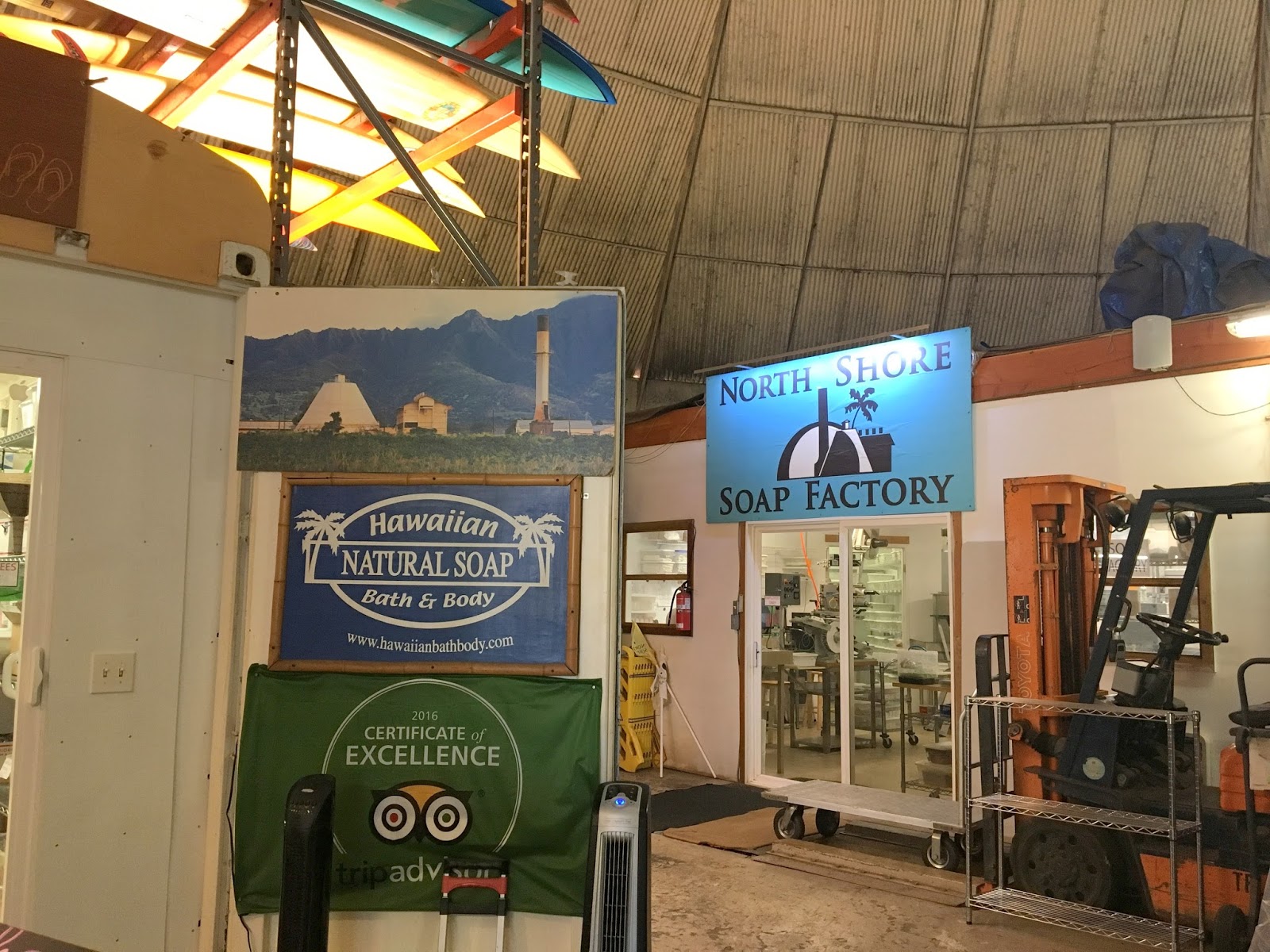
Shore Soap Factory is located in the Bagasse bin and houses the Hawaiian Bath
& Body works, selling a wide array of home products- bath-body and skin care range. The unique company was started by Debora & Jerry Driscoll some
20 plus years back when they started making soaps from their home in Pupukea
and eventually moved into the old sugar mill building in 2004 as the business boomed
and the products acclaimed international and national fame.
The products
are organic, natural and locally sourced and have the tropical scents such as pineapple,
coconut cream, kukui nut, mango, Hawaiian coffee, Pupukea tangerines,
Waikane ginger root, Maui sugar and Big Island honey and guava. Kukui Nut
and Macadamia Nut oils are carefully blended with essential oil and tropical
island flavors creating bars that are skin and ocean friendly.
Kukui Nut
Once in the
parking lot, follow the little painted rubber duckies to the entrance.
The entire
set-up has a rustic, old-world charm, with giant deserted gears from the old
mill at the entrance to the soap factory. As soon as you step into the open
warehouse like area of the soap factory, you are surrounded by the tropical
smells of soap and the aroma is so tempting you will want to eat it. Get other Hawaiian bath and body products
The rubber duckies
The Waiting area
Old sugar mill
The Bagasse Bin
The entrance to the soap room
you can stamp the soap
The old sugar mill and ocean
As you sniff
your way through the shop,you stumble upon loads of bars of soap bars in
various sizes, color and aroma tastefully displayed.
The visitors
also see a collection of historic artifacts and photos with a soap stamping
station and amazing number of rubber duckies in all shapes, sizes and color.
To the left
of the display is a glass partition and visitors can see the soap being mixed,
swirled, cut and boxed through the glass panel. There are many rows of brightly colored soaps in various
stages of drying and huge slabs of soaps ready to be cut into custom sizes.
Customers
can choose from $1 slivers to fancy gift-packs and other bath products like lip
balms, scrubs, oils, body mists, bath salts, body lotions and soap stands. Customers
can get their soaps stamped into any island style logos of their choice after
purchase. They can save money by buying the unboxed soaps.
The Lip
Balms with macadamia and kukui nut oils, organic coconut oil and just the right
amount of locally sourced organic beeswax from Big Island are huge customers
favorite. They help protect and moisturize your lips. You can choose
from eight varieties to soothe, soften, and protect delicate tissue from
the harsh elements.
Visitors can
also buy a variety of chocolates produced in Hawaii, drinks produced in Hawaii,
t-shirts, and beach bags.
coffee at the soap factory
The company
also produces special soaps and lip balms for weddings. Visitors can sometimes
watch the artist through the window hand stamping these products with special
logos. Visitors can also sometimes watch artists creating special artwork to be
stamped onto these bars and balms.
They have a
sink at the back of the store to try the different soaps and scrubs.
Visitors can
also get a customized, behind the Behind-the-Scenes tour from Tuesday through
Friday to learn more about the soap making and it’s also a great family
activity. The duration of the tour is 20-30
minutes, and accommodates Min:
2 people; Max: 15 people and costs $12 per person; well behaved kids 4 &
under are free.
variety of soaps
variety of soaps
The soap bar
Bath tiles
soaps
soaps
the rainbow soap and duckies
soaps
Bath accessories
stamping the soap
customized stamping of soap
Loofah
Hours: Open daily (except for New
Year's Day, Easter, 4th of July, Thanksgiving, and Christmas Day
The Halawa
Xeriscape Garden displays a group of plants collectively called as Xeric
or dry in a residential scale setting. It was opened in September 1989, after
several years of effort by the Board of Water Supply (BWS), to educate Oahu
residents on ways to conserve water and still have a beautiful garden and landscaped
areas.
The term
Xeriscaping was coined in the American Southwest and describes a creative and
new way of saving water by planning your garden accordingly.
This unique
demonstration garden is situated in Aiea, on the island of Oahu. People can
familiarize themselves with kinds of plants that require less water and
irrigation techniques, landscaping ideas
to make more efficient use of water.
The term
Xeriscaping is based on seven fundamental principles that can guide you to
plant and maintain a xeriscape garden.
Seven
Principles of Xeriscaping
1. Planning
and Design
Plan
and design landscapes for water conservation
Work with existing surroundings and utilize plants that are appropriate
for the area.
2. Limit Turf Areas
Minimize
unnecessary turf areas which require more water and maintenance.
In the areas where turf is utilized, use the appropriate grass for the
area.
3. Soil
Improvements
Improve
the quality of your soil by adding organic matter such as compost or manures.
Soil amendments improve water absorption and the water-holding capacity
of the soil.
4. Mulching
Mulches
protect the soil from direct sunlight which can dry out the soil.
They minimize evaporation, inhibit weed growth and slow erosion.
Some mulches such as wood chips break down over time and add organic
matter which enriches the top soil.
5. Efficient
Irrigation
Plants
should be watered early in the morning or in the evening to prevent moisture
loss due to evaporation.
Drip irrigation is one example of an efficient irrigation system.
6.
Appropriate Maintenance
Keep
your plants healthy by practicing routine basic maintenance, such as proper
pruning and regular pest control.
Pests are attracted to weak or dying plants.
7.
Appropriate Plant Selection
Select
plants that are suited for the area to minimize water use and maintenance efforts.
Group plants that have similar water requirements
In general, native plants require less water and maintenance.
Among the
water-efficient irrigation systems demonstrated in the Halawa Xeriscape Garden
are automatic timers, moisture sensors, rain shutdown devices, and low output
irrigation equipment such as spray sprinkler heads, micro-spray sprinkler
heads, emitters and dripper lines.
It also
includes zoning the landscapes making the best use of natural climate conditions,
creating microclimate zones and dividing the garden into water zones.
There is a
wide range of unthirsty plants and hence the garden in divided into different
sections to display the entire range.
The Hawaiian Garden showcases native Hawaiian plants that are adapted to
hot and dry climate and includes attractive and readily grown species that
requires far less water than the native exotics. Some of the native Hawaiian drought
resistant plants are Āwikiwiki,Hinahina,Pohinahina, Uki ‘Uki ,‘A‘ali‘I,‘Ilima,Naio, Koa and
Lama.
Hinahina--Heliotropium anomalum
‘A‘ali‘i--Dodonaea viscosa
Kokio ke‘oke‘o--Hibiscus arnottianus
‘Ilima--Sida fallax
Ōhi‘a --Metrosideros spp
Koa tree
Naio--Myoporum sandwicense
The
International Garden boasts
a collection of plants from the world's dry tropics. It includes newly-introduced
experimental species whose reaction to varying levels of drought will be
evaluated over the next several years. The introduction and evaluation program
is an important aspect of the xeriscape project.
The Indian Curry leaves tree
The Cotton tree
Aakada or Calotropis gigantea
The
Bromeliad Garden features
a collection of "less thirsty" pineapple relatives from the tropics
of the New World. This garden presents a kaleidoscopic palette of species of
widely varying forms and sized for both sun and shade in the Xeriscape.
The Tree
Garden is a
collection of drought-tolerant tree species, including several experimental
species from all over the globe.
The garden is
located at 99-1268 Iwaena Street, Aiea HI 96701. Admission is
free and is open to the public on Wednesdays and Saturdays from 9 a.m. to 3
p.m. Self-guided tours can be taken at any time while guided tours are offered
by appointments.
The garden
also holds lot of workshops throughout the year.The workshops
includes instruction on how to xeriscape, efficient irrigation, propagating
native plants that save water, soil improvement/mulching, lei-making with
xeriscape plants, and wreath-making with xeriscape plants, among others. You
can call on (808) 748-5041 to get more
information. Driving directions to Hlawa Xeriscape Garden
The garden
also holds regular events like Garden Open House and Unthirsty Plant Sale.Less-thirsty plants for sale included the Hoya, Talinum,
Resnova, Stephanotis and many other drought-tolerant succulents. Keikiscapes
are snapshots of activities done by Hawaiian keiki on open house day.
Free
Xeriscape Seeds
Every first
Wednesday of the month, Halawa Xeriscape Garden offers free xeriscape seeds.
The packets can be picked up on Wednesdays or Saturdays from 9 a.m. to 3 p.m
The Friends
of Halawa Xeriscape Garden (FOHXG) is a non-profit community organization
dedicated to educational programs that promote water conservation on the
landscape. Established in 1989, the Friends have continued to provide support
through volunteers and educational activities for the Garden's landscape water
conservation program.


 PRODUCTS